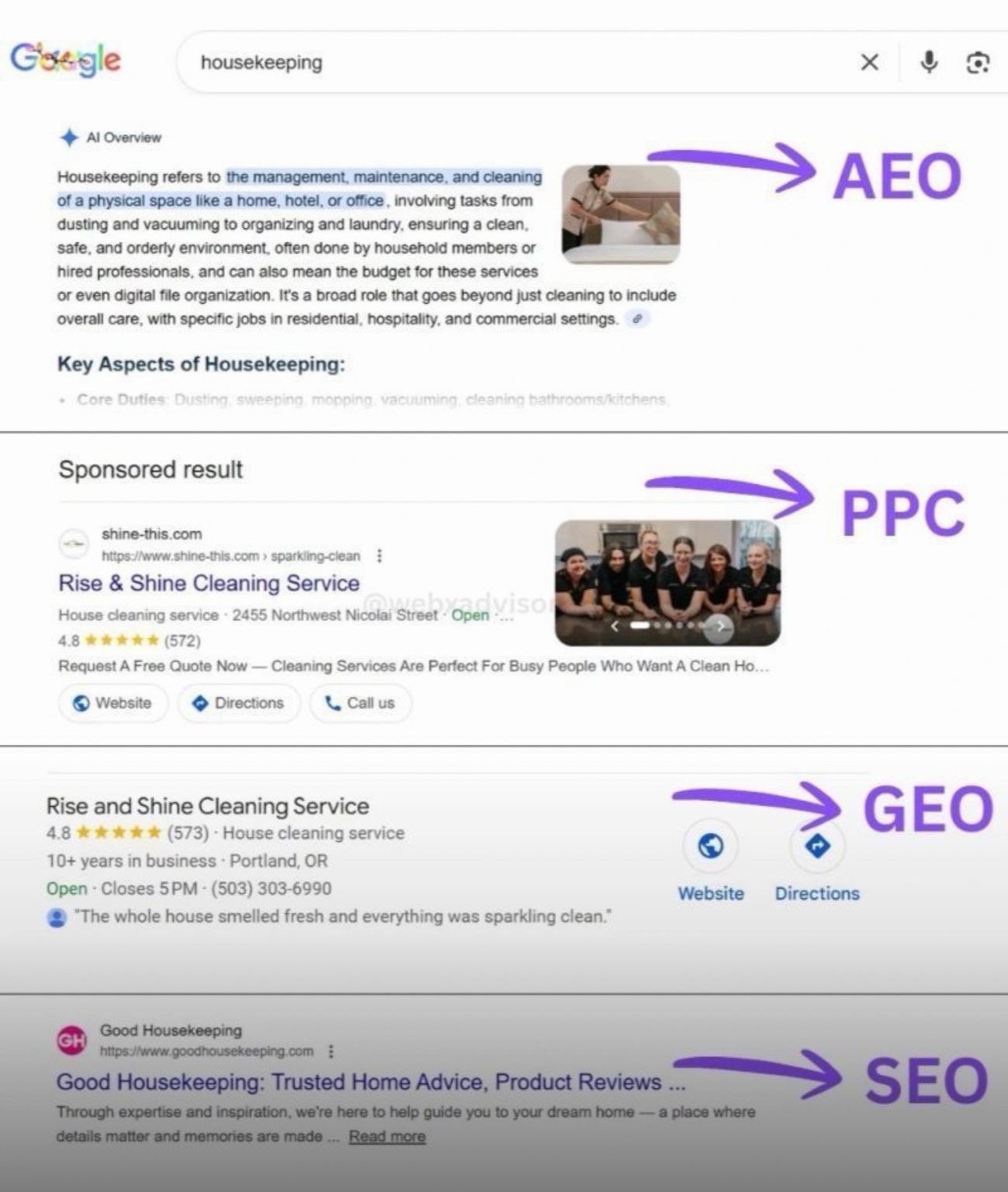
One Keyword. Four Search Experiences.
Why SEO Alone Is No Longer Enough in 2026
Search has fundamentally changed — and most businesses haven't noticed. When you search for a single keyword in 2026, you're not seeing one ranking system anymore. You're seeing four completely different visibility channels competing for attention — all on the same page, all with different rules.
AEO — AI-generated answers at the top of the page
PPC — Paid ads and sponsored results
GEO — Google Maps and AI-powered local results
SEO — Classic blue link results, now at the bottom
The Critical Shift: If your strategy only focuses on "SEO," you're invisible in three-quarters of modern search.
Understanding the Four Search Experiences
Before we break down each channel in detail, it's important to understand what's fundamentally different about 2026 search.
In 2015: One search = Google's rankings = blue links
In 2026: One search = AI answers + Ads + Maps + Organic results = four completely different visibility systems
When a potential customer searches for your service, Google no longer shows them "the best results." It shows them an AI's interpretation of the answer, paid advertisers with the highest bids, local businesses closest to them, and traditional organic results based on authority and relevance.
Channel 1: AEO (AI Engine Optimization)
The New Top of the Funnel
AI Engine Optimization (AEO) is the practice of optimizing your content, brand signals, and digital presence so AI systems cite and reference your business when answering user questions.
This includes Google AI Overviews, ChatGPT answers, Perplexity summaries, Claude responses, and Gemini results.
Why It Matters:
AI Overviews often appear before all other results — including ads, maps, and organic listings. When an AI answers a question, users may never scroll. They may never click through. They simply get an answer informed by your content (or your competitor's).
This creates a paradox: Your content can power an answer without you getting credit or clicks.
Key AEO Ranking Factors:
AI systems evaluate:
- Topical Authority — Do you deeply understand this topic?
- Content Structure — Can AI easily extract your answer?
- Brand Credibility — Are you cited and trusted across the web?
- Original Research or Insights — Do you offer something unique?
- First-Hand Experience — Do you demonstrate real expertise?
- Citation Patterns — How often are you referenced by other trusted sources?
Optimization Tactics for AEO:
Create Clearly Structured Content
AI pulls from content that's easy to parse: use short paragraphs, bold key points, numbered lists, definition-first explanations, and TL;DR sections.
Build Topical Authority
Create comprehensive coverage of your core topics. Write 10-20 pieces on different aspects of your main service and link them together conceptually.
Demonstrate Original Expertise
AI favors original insights: share case studies with real numbers, publish original research, document your process and results.
Create Author Authority
Use author schema on your site, maintain a professional author bio, get featured in industry publications, publish under your real name.
Monitor AI Citations
Use tools to track which of your content appears in AI answers and optimize based on what's cited.
Channel 2: PPC (Pay-Per-Click Ads)
Immediate Visibility With Ongoing Cost
Pay-Per-Click (PPC) advertising allows businesses to bid for instant placement at the top of search results. Advertisers pay only when someone clicks their ad.
Why It Still Matters:
PPC remains powerful because:
- It captures high-intent traffic immediately
- You control the messaging and landing page
- Results are measurable and trackable
- You're visible above organic results
- It works even if you're new and have no organic authority
Why PPC Alone Isn't Enough:
- Visibility ends when you stop paying — The moment your budget runs out, you disappear
- Costs are rising — Competitive industries see year-over-year increases of 10-20%+
- AI Overviews reduce engagement — When users get answers from AI, ad click-through rates drop
- You're competing with millions of advertisers — Scale requires larger budgets
- No long-term asset building — Paid campaigns don't build organic authority or brand equity
The Smart PPC Strategy in 2026:
High-performing businesses use PPC strategically:
- To support long-term visibility (not replace it)
- For high-intent, ready-to-convert keywords (not broad awareness)
- To amplify what already converts (not test random audiences)
- To buy time while building organic visibility (not as a permanent solution)
PPC Optimization for Maximum Efficiency:
- Focus on high-intent keywords — Target people ready to buy
- Optimize landing pages — Drive traffic to pages relevant to the ad
- Use ad copy that addresses pain — "Emergency service" converts better than generic copy
- Set realistic daily budgets — Avoid overspending on low-intent keywords
- Use smart bidding strategies — Maximize conversions, not clicks
- Test and iterate — Small improvements multiply across clicks
Channel 3: GEO (Generative & Local Experience Optimization)
Maps + AI-Powered Local Results
Why This Is Critical (Especially for Home Services):
Home service businesses live or die by local visibility. When someone searches "service near me," they don't care about national authority. They care about who's closest, who has the best reviews, and who can come quickly.
How GEO Works:
Google's ranking factors for Maps include proximity, relevance, and prominence:
- Proximity: How close are you to the searcher?
- Relevance: Does your Google Business Profile match what they're searching for?
- Prominence: How well-known and trusted are you locally?
GEO Optimization Tactics:
1. Optimize Your Google Business Profile Completely
- Accurate business name, address, phone (NAP)
- Clear, specific primary category
- 3-5 secondary categories (related services)
- Complete business description (keyword-relevant)
- All available attributes activated
- 10+ high-quality photos
- Regular posts (at least 1-2 per month)
- Prompt responses to questions and reviews
2. Generate Consistent Review Velocity
Aim for 3-5 new reviews per month. Respond professionally to all reviews (positive and negative). Never incentivize reviews.
3. Build Local Citations
Ensure consistent NAP across all directories. List on industry-specific and local directories. Prioritize high-authority citations.
4. Strengthen Your Website's Local Authority
Create location-specific pages, build internal links between related pages, get local backlinks.
Channel 4: SEO (Traditional Organic Results)
Still Important, But No Longer Alone
Why SEO Still Matters:
- Long-form content builds authority and trust
- Backlinks establish credibility
- Topical expertise compounds over time
- Organic traffic is "free" once achieved
- Authority built through SEO feeds AEO, GEO, and your overall brand
Why SEO Alone Isn't Enough:
Notice where the traditional organic result appears: at the bottom, after AI answers, ads, and local results. Users who reach organic results have already seen AI answers, seen paid ads, and seen local businesses. You're competing for scraps at the bottom.
The Role of SEO in Multi-Channel Strategy:
SEO in 2026 is best used as:
- Authority building — Establishing topical expertise that feeds AI and GEO
- Content marketing — Providing the depth and originality that builds trust
- Support channel — Ranking for lower-intent queries
- Long-term asset — Building organic visibility that never requires paying
Core SEO Tactics:
1. Technical Excellence
- Fast page load (under 2 seconds)
- Mobile optimization
- Clean site structure
- Proper schema markup (FAQ, Service, Local Business)
2. Content Authority
- Topic clusters (pillar pages supported by detailed articles)
- Comprehensive coverage (beat competitors by being more thorough)
- Original insights or research
- Author expertise signals
3. Backlink Building
- Earn links from industry publications
- Get featured on authority websites
- Build relationships with industry peers
4. Topical Relevance
- Create content around core service topics
- Build related content that connects thematically
- Help AI understand your expertise area
How the Four Channels Work Together
The Multi-Channel Ecosystem
The power of understanding all four channels isn't just awareness — it's synergy. When optimized together, they amplify each other.
The Flywheel Effect:
Strong GEO (Maps + AI-Local) → Builds Review Velocity + Trust → Improves AEO Citations → Strengthens Brand Authority → Improves SEO Rankings → Attracts More Backlinks → Increases Content Authority → Improves All Channel Performance → (Cycle strengthens)
The Mistake Most Businesses Make:
They optimize channels in isolation: "Let's run PPC while we build SEO," "Let's optimize our GBP separately," "Let's publish blog content" — but they never connect them.
These independent efforts generate results, but not optimal results.
Frequently Asked Questions
Do I really need to optimize all four channels?
Not necessarily, but the channels that matter for your business are non-negotiable. For a local service business, GEO and AEO are critical. For a software company, AEO and SEO are critical. Ignoring the critical channels for your business puts you at a severe disadvantage.
Which channel drives the most revenue?
For most service businesses: GEO (Maps) drives the most immediate revenue. AEO and SEO drive long-term authority. PPC fills gaps while you're building organic visibility. Together, they're stronger than any single channel.
How long before I see results in each channel?
GEO (Maps): 30-90 days if optimized completely. PPC: 1-7 days immediate, 30 days to optimize. SEO: 60-180 days. AEO: 60-180 days as authority builds.
How much budget do I need to optimize all four channels?
Low competition: $1,500-3,000/month. Medium competition: $3,000-8,000/month. High competition: $8,000-15,000+/month. Start with foundation work, then expand based on results.
Should I hire an agency or do this in-house?
In-house works if you have time and expertise. Agencies work if you want faster results and expert strategy. Hybrid (some tasks in-house, some outsourced) is often the best balance.
How do I know if I'm being cited in AI answers?
Search your target keywords in ChatGPT, Perplexity, and Google AI. Look for your business referenced in the AI answer. Use monitoring tools to track changes over time.
My GBP shows the wrong address. Will this hurt my rankings?
Yes, significantly. Incorrect business information confuses both Google's algorithm and customers. Fix it immediately. Changes take 7-30 days to propagate.
How many reviews do I need to rank well in Maps?
20+ reviews signals basic authority, 50+ signals strong authority. More important than total count is consistency — 3 reviews per month beats 50 reviews from 2 years ago.
If SEO alone isn't enough, should I stop investing in it?
No. SEO builds long-term authority that feeds into AEO, GEO, and overall brand credibility. Don't skip SEO; just don't rely on it exclusively. Pair it with GEO/AEO.
What's a good ROI for PPC?
2:1 (spend $1, make $2) is minimum viable. 3:1 is good. 5:1 is excellent. Calculate: (Revenue from PPC customers - Cost of ads) / Cost of ads = ROI.
Why 2026 Is the Year of Multi-Channel Optimization
Search has fundamentally changed. In 2015, winning meant ranking #1 on Google. In 2026, winning means being visible across all four channels — and having them work together.
The brands that understand this and act on it are dominating their markets. The brands that treat each channel as separate are struggling with declining visibility and increasing costs.
Ready to Win All Four Search Channels?
If your business relies on local visibility, phone calls, or bookings, you can't afford to optimize for just one channel anymore.
Get a multi-channel search strategy audit from D&D SEO Services. We'll analyze where you stand in all four channels and show you exactly how to integrate them for maximum visibility and revenue.
Explore our local SEO services including AI-powered optimization, comprehensive audits, and GBP management.
📞 (239) 276-8138
Request Your Free Multi-Channel Search Audit
The Strategist Behind D&D SEO Services
I’m Danielle Birriel, founder of D&D SEO Services. For over 12 years, I’ve been helping local service businesses—from plumbers and HVAC companies to medspas, dentists, and in-home care providers—outrank competitors, attract more qualified leads, and turn online searches into paying customers.
I’m not here to sell you “SEO in a box.” I’m here to solve real problems local business owners face every day:
- You’re buried on Google while competitors dominate the top spots.
- Your phone isn’t ringing enough despite having great services.
- Your Google Business Profile isn’t optimized and isn’t bringing in leads.
- You’ve been burned by agencies promising results but delivering cookie-cutter strategies.
- You don’t know if your marketing is actually working because you’re not getting transparent reporting.
I built D&D SEO Services to change that.