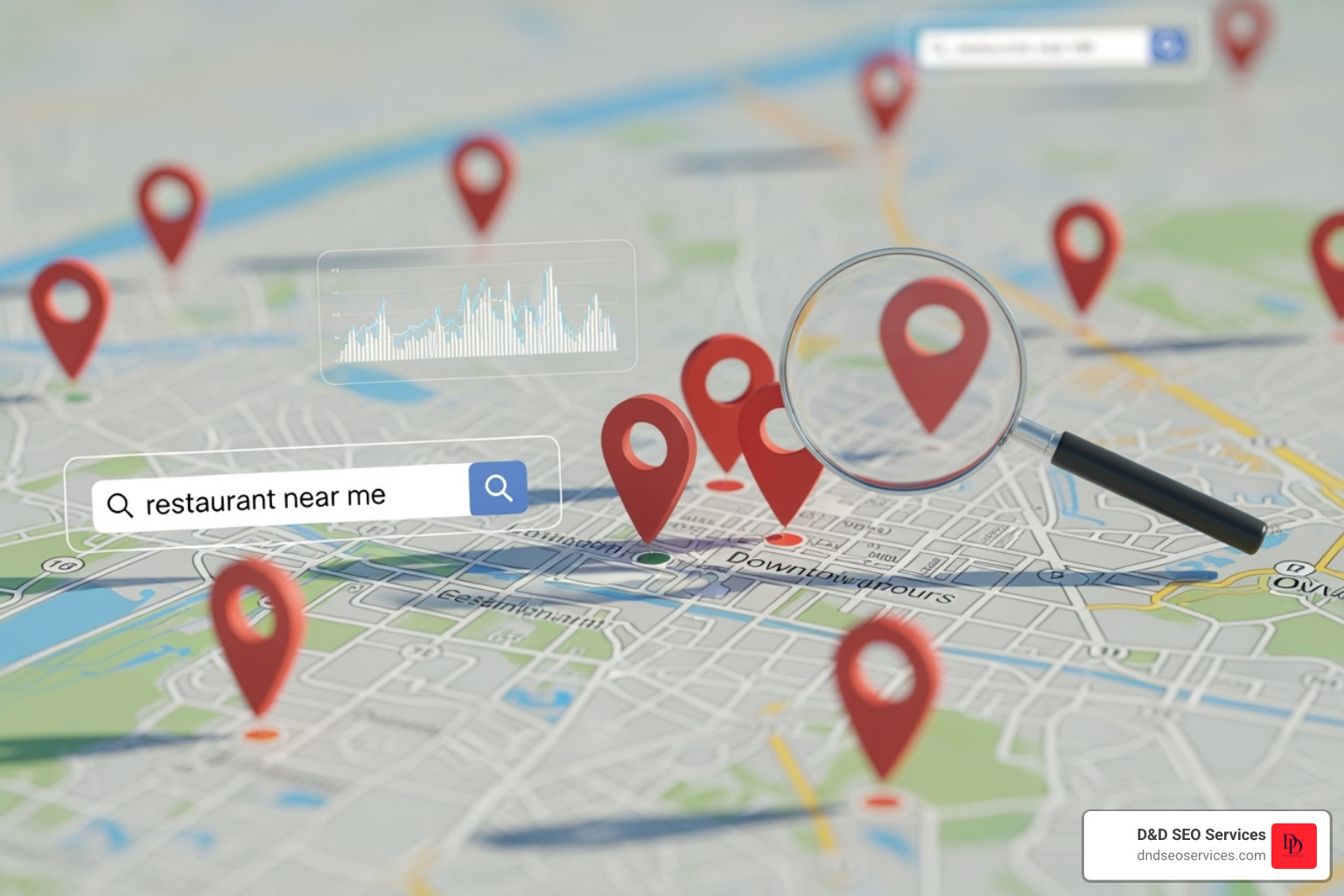

SEO Beyond Google: How Local Businesses Can Show Up Everywhere Customers Search in 2026
Google is still the largest search engine — but it's no longer the only place customers find local businesses. AI assistants, voice search, and AI-powered answer engines now influence which businesses get calls, visits, and revenue.
This guide breaks down every platform where local customers search in 2026, what it takes to show up in each one, and how to build a unified strategy that connects traditional SEO with AI-powered visibility — so your business gets found no matter where the search starts.
TL;DR
Customers now search on Google, Google Maps, AI Overviews, ChatGPT, Perplexity, Gemini, and voice assistants — often before they ever visit a website. Local businesses that only optimize for traditional Google rankings miss growing segments of high-intent searchers. A unified SEO strategy that covers traditional search, Maps, and AI platforms creates compounding visibility that single-channel optimization can't match.
Why Isn't Google Enough Anymore for Local Businesses?
Google still processes over 8.5 billion searches per day — but it's no longer where every customer journey begins. 45% of consumers now use AI tools to find local services, up from 6% just a year ago. ChatGPT handles 72 billion messages per month. Google AI Overviews reach 1.5 billion monthly users. And voice assistants field millions of "near me" queries daily.
For local service businesses, this means your potential customers are asking ChatGPT "who's the best plumber in Fort Myers," telling Siri "find an HVAC company near me," and getting AI-generated answers from Google before they ever see a traditional search result. If your business isn't structured to appear in these answers, you're invisible to a growing share of high-intent buyers.
The critical insight: AI search visitors convert at 4–5x the rate of traditional organic visitors. The volume is smaller (for now), but the quality is dramatically higher. Businesses that show up in AI answers capture customers who are further along in their decision process — past research, ready to act.
of consumers now use AI tools to find local services — up from 6% one year ago. (Source: BrightLocal 2026)
Where Are Local Customers Actually Searching in 2026?
Local customers search across six distinct platforms in 2026 — and each one uses different signals to determine which businesses to show. Understanding these platforms isn't optional; it's the foundation of a complete visibility strategy.
Google Search (Organic Results)
Traditional organic listings still drive the majority of local discovery traffic. Ranking here requires on-page SEO, technical health, content depth, backlinks, and E-E-A-T signals. This is the foundation everything else builds on — AI platforms and voice assistants both pull from content that ranks well in traditional search.
Google Maps & Local Pack
The Map Pack captures 75% of all local clicks. Visibility here depends on your Google Business Profile — completeness, category accuracy, review volume and quality, posting frequency, and NAP consistency. For local service businesses, Map Pack presence often matters more than organic position #1.
Google AI Overviews
AI Overviews now appear for a significant share of local queries, synthesizing answers from multiple sources before the user sees any organic results. To appear here, your content needs answer-first structure, clear entity data, FAQ sections, schema markup, and topical authority. AI Overviews pull from pages Google already trusts — traditional SEO is the prerequisite.
ChatGPT, Perplexity & Gemini
AI assistants now recommend local businesses by name when users ask conversational questions like "who should I call for roof repair in Naples?" These platforms cite sources with strong authority signals, consistent entity data, and structured content. Only 1.2% of local businesses appear in ChatGPT recommendations vs. 35.9% in Google's Map Pack — meaning AI visibility is 30x harder to achieve but dramatically less competitive for those who earn it.
Voice Search (Siri, Alexa, Google Assistant)
Voice queries are conversational and high-intent — "find a dentist open now near me." Voice assistants pull answers from Google's featured snippets, Maps data, and structured content. Optimizing for voice means optimizing for natural language, FAQ-style content, and local schema — the same patterns that drive AI Overview visibility.
Google AI Mode (Emerging)
Google's AI Mode is a fully conversational search experience — no blue links, just AI-generated answers with citations. Early data shows it pulls from the same trust signals as AI Overviews but in a more selective, citation-based format. Businesses with strong traditional SEO foundations, active GBP profiles, and well-structured content are positioned to appear here as it rolls out.
How Do AI Platforms Decide Which Local Businesses to Recommend?
AI platforms don't rank pages the way Google does. They select sources to cite based on entity authority, content structure, and third-party validation — then synthesize answers from those sources. Understanding how this differs from traditional ranking is critical to getting recommended.
Entity Authority Over Page Authority
AI doesn't recommend pages — it recommends entities (businesses). Your business needs consistent identity signals everywhere: same name, phone, address, and service descriptions across your website, GBP, directories, and schema markup. The more consistently you appear as a known, verified entity, the more likely AI platforms cite you.
Structured Content for Extraction
AI platforms extract answers from content structured for machine readability. Answer-first paragraphs, FAQ sections, comparison tables, numbered steps, and clear heading hierarchies all increase extraction likelihood. Content that buries answers in long narratives gets skipped.
Third-Party Validation
AI platforms frequently cite independent sources over business websites. Reviews on Google and Yelp, mentions in local media, directory listings, and industry publications all serve as third-party validation. Businesses with strong off-site presence get recommended more often than those with great websites but no external footprint.
Content Freshness & Review Signals
Recent reviews, updated GBP posts, and fresh content signal that a business is active and relevant. AI platforms deprioritize stale entities. A business with 200 reviews from three years ago and no recent activity gets passed over in favor of a competitor with 80 reviews that are growing monthly.
What Is the Difference Between GEO, AEO, and Traditional SEO?
These three disciplines overlap heavily, but they target different outcomes. Understanding where they connect — and where they diverge — helps you invest in the right strategy for your business.
| Discipline | What It Targets | Goal |
|---|---|---|
| Traditional SEO | Google Search & Maps organic rankings | Rank pages for clicks and traffic |
| AEO (Answer Engine Optimization) | Featured Snippets, AI Overviews, voice answers | Structure content so AI can extract and cite it |
| GEO (Generative Engine Optimization) | ChatGPT, Perplexity, Gemini, AI assistants | Get your business recommended by AI platforms |
The practical overlap is significant. Research shows that GEO-optimized content boosts AI visibility by 40%, and the core tactics — answer-first content, entity consistency, schema markup, and authority signals — improve performance across all three disciplines simultaneously.
For local service businesses, the smartest approach isn't choosing between these — it's building a foundation that serves all three. Strong traditional SEO makes you eligible for AI Overviews. AEO-structured content makes you extractable by voice assistants. GEO tactics make you recommendable by ChatGPT and Perplexity. They're layers, not alternatives.
How Do You Build a Search-Everywhere Strategy for a Local Business?
A unified visibility strategy doesn't require separate campaigns for each platform. It requires building a strong foundation that compounds across all of them — then adding platform-specific optimizations where they matter most.
Layer 1: Traditional SEO Foundation
Every other platform builds on this. Your website needs technical health (fast, mobile-friendly, crawlable), on-page optimization with city-specific keywords, dedicated service and location pages structured as silos, strong internal linking, and quality backlinks from local sources. Without this foundation, AI platforms have nothing to cite.
Layer 2: Google Business Profile & Maps
Your GBP is often the first thing customers see — and it's the primary data source for Google AI Overviews and voice assistants. Complete every field, select accurate categories, maintain consistent NAP, post weekly updates, collect reviews systematically, and respond to every review. Businesses with active GBPs rank in the Map Pack 36% more often than dormant profiles.
Layer 3: AI-Ready Content Structure
Structure every page for extraction. Answer-first paragraphs under question-based headings. FAQ sections with direct answers. Comparison tables. Numbered steps. Schema markup (LocalBusiness, FAQ, Service, Breadcrumb). This is what makes your content eligible for AI Overviews, Featured Snippets, and voice answers — simultaneously. See our content structure for AI extraction guide for the complete pattern.
Layer 4: Entity & Authority Signals
Build your business as a known entity across the web. Consistent NAP in every directory. Author attribution on content. Mentions in local media. Active presence on review platforms. Schema that connects your website, GBP, and social profiles into a coherent entity graph. These signals are what AI platforms use to decide whether your business is trustworthy enough to recommend.
Layer 5: AI Visibility Monitoring
Track whether AI platforms mention your business. Search your own "money prompts" (the queries you most want to own) in ChatGPT, Perplexity, and Google AI Overviews. Screenshot results monthly. Note which competitors appear and what content they're being cited for. This reconnaissance tells you exactly where your gaps are and what to build next.
What Content Formats Work Best Across Multiple Search Platforms?
Different platforms favor different formats — but certain content types perform well across all of them simultaneously. Prioritize these formats to get maximum cross-platform value from every piece of content you create.
| Content Format | Google Organic | AI Overviews | ChatGPT / Perplexity | Voice Search |
|---|---|---|---|---|
| FAQ sections | ✅ Rich results | ✅ High extraction | ✅ Cited frequently | ✅ Direct answers |
| Answer-first paragraphs | ✅ Featured snippets | ✅ Primary source | ✅ High citation rate | ✅ Read aloud |
| Comparison tables | ✅ Table snippets | ✅ Extracted as data | ✅ Structured answers | ❌ Not voice-friendly |
| Numbered step lists | ✅ List snippets | ✅ High extraction | ✅ Process answers | ✅ Sequential delivery |
| Definition blocks | ✅ Position zero | ✅ Lead extraction | ✅ Definitional citations | ✅ Direct answers |
| Long-form guides | ✅ Authority signal | ✅ Multi-section source | ✅ Comprehensive citing | ❌ Too long for voice |
The pattern is clear: content structured for machine extraction performs across every platform. FAQ sections, answer-first paragraphs, and numbered steps are the highest-value formats because they serve Google, AI Overviews, ChatGPT, and voice search simultaneously.
This is why AEO (Answer Engine Optimization) isn't a separate strategy — it's the content layer that makes your traditional SEO work harder across every search surface.
How Hard Is It to Show Up in AI Search vs. Google?
Significantly harder — but the competition is dramatically lower, and the conversion quality is dramatically higher. The data from SOCi's 2026 Local Visibility Index makes the contrast stark.
| Platform | % of Local Businesses Appearing | Difficulty Level |
|---|---|---|
| Google Local 3-Pack | 35.9% | Competitive |
| Perplexity | 7.4% | Very selective |
| Gemini | 11% | Selective |
| ChatGPT | 1.2% | Extremely selective |
AI visibility is 3–30x harder to achieve than traditional local search ranking. But here's the opportunity: the vast majority of your competitors aren't even trying. While most local businesses focus exclusively on Google, the businesses that invest in entity authority, structured content, and third-party validation now build an AI visibility moat that competitors will spend years trying to close.
And the traffic quality justifies the effort. Visitors from AI platforms convert to customers at 4–5x the rate of traditional organic visitors — because AI pre-qualifies them by answering their preliminary questions before they ever reach your site.
How Do You Measure Visibility Beyond Google Rankings?
Traditional SEO measurement — keyword positions, organic traffic, click-through rates — doesn't capture AI visibility. You need additional metrics to understand your total search footprint across platforms.
Metrics That Matter in 2026
- AI citation frequency: How often AI platforms mention your business when answering relevant queries. Track by searching your money prompts monthly across ChatGPT, Perplexity, and Google AI Overviews.
- Share of voice in AI answers: Your mention rate vs. competitors for the same queries. If three competitors appear in ChatGPT answers and you don't, that's a visibility gap you need to close.
- Referral traffic from AI: Set up analytics dimensions to identify visitors arriving from LLM platforms. This traffic is small but growing fast and converts at significantly higher rates.
- GBP engagement metrics: Views, calls, direction requests, and bookings from your Google Business Profile — the data that connects Maps visibility to revenue.
- Traditional organic metrics: Rankings, organic traffic, and conversions from Google Search — still the volume driver for most local businesses.
- Review velocity and sentiment: New reviews per month, average rating trend, and response rate — signals that influence both Google and AI platforms.
The key shift: stop measuring success by a single platform. Your total visibility footprint is the combination of Google organic position, Map Pack presence, AI Overview appearance, AI platform citations, and voice search answers. Tracking all five gives you the complete picture of where customers can find you — and where they can't.
What Should Local Businesses Do First?
Start with the actions that compound across the most platforms simultaneously. Don't try to optimize for everything at once — build the foundation that makes every subsequent layer easier.
Priority Actions (in Order)
- Optimize your Google Business Profile completely — this single asset feeds Google Search, Maps, AI Overviews, voice search, and Gemini simultaneously
- Structure your website content for AI extraction — answer-first paragraphs, FAQ sections, schema markup on every page
- Build entity consistency — same NAP, same service descriptions, same brand data across every platform and directory
- Invest in reviews systematically — volume, recency, and quality influence every platform from Maps to ChatGPT
- Earn local authority signals — media mentions, local backlinks, directory listings that third-party validation your business as real and trusted
- Monitor AI visibility monthly — search your money prompts across AI platforms and track whether you appear, who competes with you, and what content gets cited
Every action on this list improves your visibility across multiple platforms simultaneously. That's the compounding advantage of a search-everywhere approach vs. single-channel optimization — the work you do once pays dividends across Google, Maps, AI Overviews, ChatGPT, Perplexity, and voice search at the same time.
For a deeper look at how we structure this for clients, explore our local SEO services and AI-powered SEO approach.
Frequently Asked Questions
Does optimizing for AI search replace traditional SEO?
No. Traditional SEO is the foundation that AI visibility builds on. AI platforms cite content that already ranks well in Google, has strong authority signals, and is structured for extraction. You can't skip traditional SEO and jump straight to AI optimization — but you can structure your traditional SEO work so it serves both purposes from the start.
How much AI search traffic should local businesses expect in 2026?
AI search currently represents about 1–2% of total search traffic for most businesses — but it's growing 60x faster than traditional search. The traffic is small in volume but converts at 4–5x higher rates. Early movers build visibility now while competition is low, positioning themselves to capture disproportionate share as adoption accelerates.
Can a small local business actually appear in ChatGPT recommendations?
Yes, but it requires specific signals: consistent entity data across the web, strong review presence on Google and other platforms, mentions on third-party sites (directories, local media, industry listings), and well-structured content on your own website. Only 1.2% of local businesses currently appear in ChatGPT — which means the opportunity for early movers is enormous.
What's the relationship between Google AI Overviews and traditional rankings?
AI Overviews pull from pages that Google already trusts and ranks well organically. If you rank on page 1 for a query, you're eligible for the AI Overview. If you're on page 3, you're not. Traditional SEO is the prerequisite — content structure for AI extraction is the additional layer that increases your chances of being selected.
How does voice search fit into this strategy?
Voice assistants pull answers from Google's Featured Snippets, Maps data, and structured content. The same optimizations that drive AI Overview appearance — answer-first paragraphs, FAQ schema, clear entity data — also make your content the answer voice assistants read aloud. You don't need a separate voice search strategy; you need content structured for extraction.
Should I invest in social media SEO (TikTok, Instagram) for local service businesses?
For most local service businesses (plumbers, HVAC, dentists, roofers), social media is a secondary discovery channel — not a primary search channel. Your priority should be Google Search, Maps, AI Overviews, and AI assistants. Social presence supports brand authority signals, but the highest-ROI investment for local service businesses remains traditional SEO + AI visibility optimization.
How long does it take to build AI search visibility?
AI visibility builds on the same timeline as traditional SEO authority — 6–12 months for meaningful results. Entity consistency and structured content can be implemented immediately, but the authority signals AI platforms rely on (reviews, backlinks, third-party mentions) accumulate over time. The businesses that start now will have a compounding advantage over those that wait.
What tools can track AI search visibility?
The category is still maturing. Manual monitoring (searching your key queries in ChatGPT, Perplexity, and Google AI Overviews monthly) is the most reliable approach for most local businesses. Enterprise tools from Semrush, Profound, and specialized platforms offer automated tracking, but coverage varies. The most important thing is consistency — tracking the same queries across the same platforms every month to identify trends.
Ready to Show Up Everywhere Your Customers Search?
Your competitors are visible on Google. The question is whether you're also visible in AI Overviews, ChatGPT, Perplexity, and voice search — where the next wave of customers is already searching.
📞 Call: (239) 276-8138
Request Your Free SEO Audit | Contact Us
📧 Email: dndseoservices@gmail.com | 🌐 Website: dndseoservices.com
✅ 100+ businesses served | ✅ 12+ years of expertise | ✅ Fort Myers, FL
The Strategist Behind D&D SEO Services
I’m Danielle Birriel, founder of D&D SEO Services. For over 12 years, I’ve been helping local service businesses—from plumbers and HVAC companies to medspas, dentists, and in-home care providers—outrank competitors, attract more qualified leads, and turn online searches into paying customers.
I’m not here to sell you “SEO in a box.” I’m here to solve real problems local business owners face every day:
- You’re buried on Google while competitors dominate the top spots.
- Your phone isn’t ringing enough despite having great services.
- Your Google Business Profile isn’t optimized and isn’t bringing in leads.
- You’ve been burned by agencies promising results but delivering cookie-cutter strategies.
- You don’t know if your marketing is actually working because you’re not getting transparent reporting.
I built D&D SEO Services to change that.