Google Core Updates 2025: Why Your Rankings Dropped & How to Recover
Key Summary
- Core updates are regrading events—not penalties. Google changes how it evaluates all sites; some rise, others fall.
- Drops are diagnosable. Confirm timing in GA4 and Search Console; isolate affected queries/pages and patterns.
- Quality + structure beat tweaks. People-first, original, well-structured content with E-E-A-T and solid UX wins.
- A 5-phase plan works. Audit, rebuild priority pages, lift site-wide quality, add topical authority content, iterate.
- Timelines. Early gains in 4–8 weeks; fuller recovery typically 8–16 weeks based on competition and effort.
I’m Danielle Birriel, Founder and CEO of D&D SEO Services. For over ten years, I’ve dedicated my career to helping local businesses steer the complexities of SEO to boost their visibility and connect with their community. My expertise ensures your business can efficiently tackle the challenge of understanding Google search variations by location.
Struggling After a Core Update? Get a Recovery Plan
We’ll analyze what changed, why rankings fell, and exactly how to rebuild visibility—prioritized by impact.
- Core update impact & competitor gap analysis
- Content overhaul with E-E-A-T enhancements
- Technical fixes, schema, and internal linking map
Contact: (239) 276-8138 • dndseoservices@gmail.com • dndseoservices.com/core-update-recovery
Google Core Updates 2025: Why Your Rankings Dropped & How to Recover
If your website traffic plummeted overnight, your Google rankings disappeared, and you have no idea what happened—you were likely hit by a Google Core Update.
It happens to thousands of businesses every time Google rolls out a major algorithm change. One day you’re ranking on page one. The next day you’re on page five. Your phone stops ringing. Your leads dry up. And you’re left wondering what you did wrong.
Here’s the truth: You probably didn’t do anything wrong. Google just changed the rules.
Google Core Updates are massive algorithm shifts that can devastate your search visibility—or create massive opportunities if you know how to respond. In this guide, we’ll explain exactly what’s happening to your rankings, why it happened, and most importantly, what you can do to recover and stay ahead of future updates.
Your Traffic Dropped After a Google Update: Here’s Why
Let’s start with what you’re experiencing right now. Your analytics show a sudden traffic decline. Your organic leads are down. You’re not showing up for keywords you used to own. Your Google Maps rankings tanked.
This isn’t a coincidence. It’s a Google Core Update.
What is a Google Core Update?
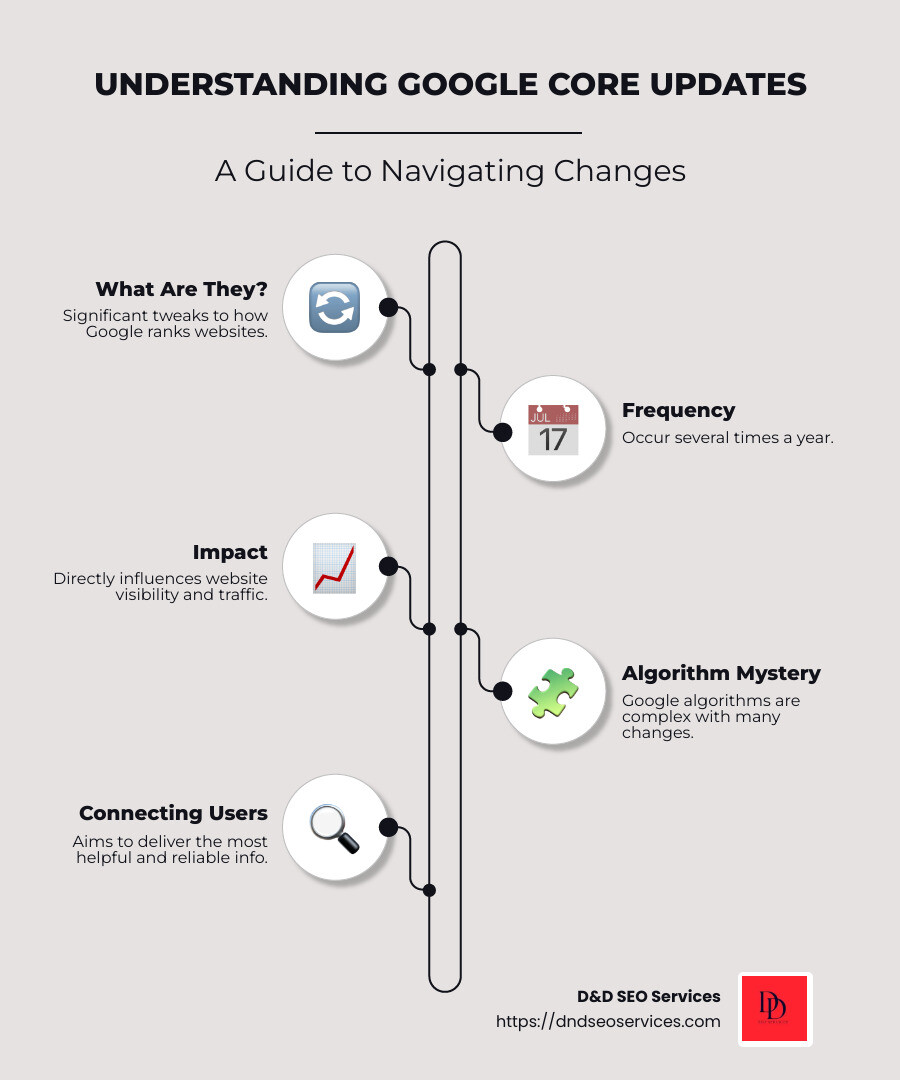
A Google Core Update is a major change to Google’s ranking algorithm—the system that determines which websites appear at the top of search results. Unlike specific algorithm tweaks that target spam or mobile optimization, core updates are broad, sweeping changes that can affect every website and every search query.
Google rolls out core updates several times per year. The most recent ones include:
- November 2024 Core Update (Started November 11, 2024)
- August 2024 Core Update (Released August 15, 2024)
- March 2024 Core Update (Completed March 28, 2024)
Each of these updates caused massive ranking shifts. In the August 2024 update alone, 44% of websites reported traffic declines, while only 27% saw improvements. If you were in that 44%, you’re not alone—and more importantly, you can recover.

Why Google Core Updates Hurt Some Businesses But Not Others
Here’s what most business owners get wrong about Core Updates:
They think they got “penalized.”
Wrong. Core Updates don’t penalize individual websites. They recalibrate how Google evaluates all websites. Think of it like a teacher re-grading everyone’s papers with a new rubric. Some papers that got A’s before now get B’s. Not because they got worse—but because the grading standard changed.
The real reason your rankings dropped:
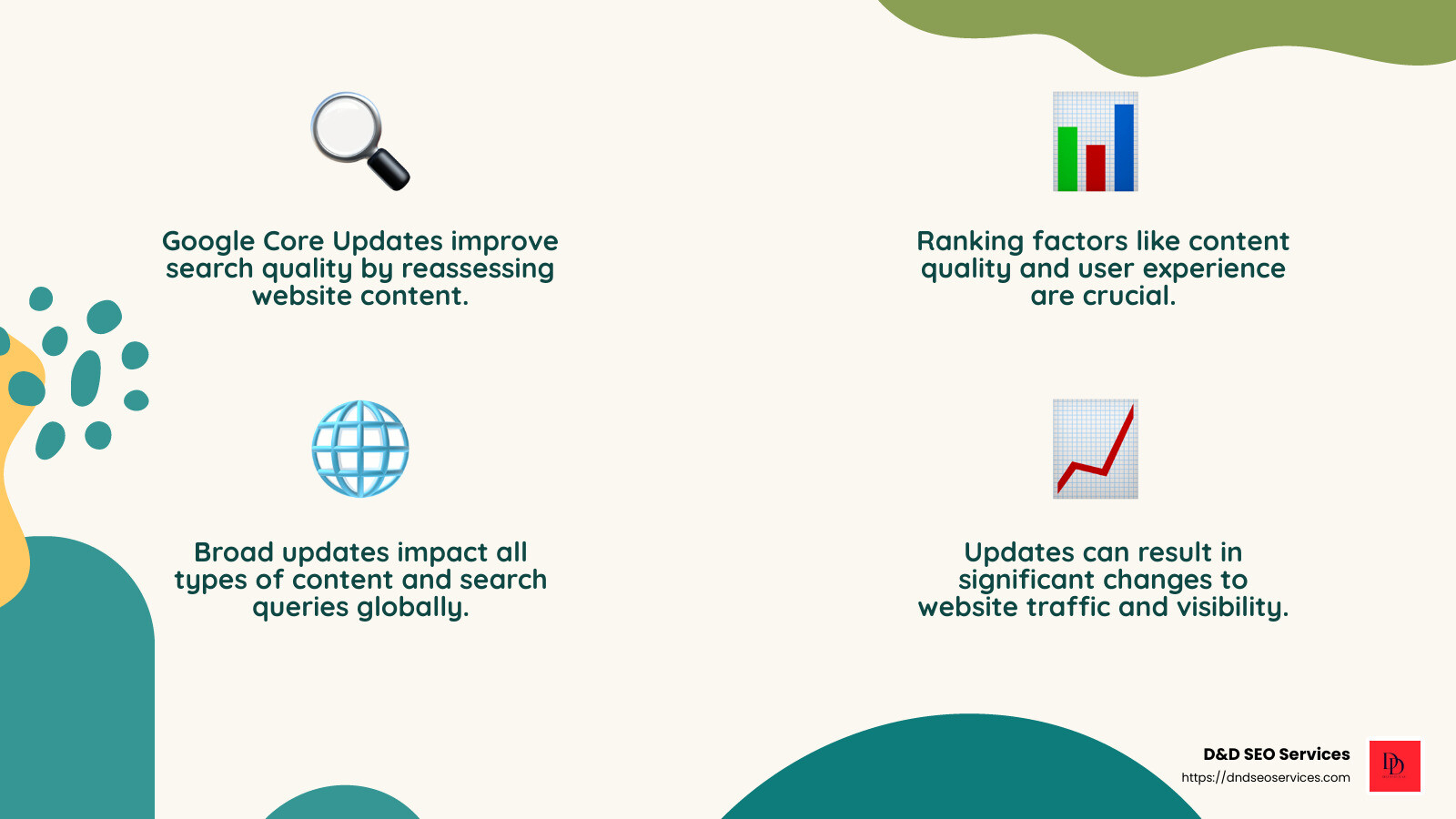
When Google updates its algorithm, it’s looking for websites that meet new quality standards. These standards shift with every update. In recent updates, Google has been increasingly focused on:
- Genuine, people-first content — Content written for humans, not for search engines
- Original research and insights — Not just recycled information from other websites
- User experience — Fast loading times, mobile-friendly design, clear navigation
- Demonstrated expertise — Evidence that you know what you’re talking about
- Trustworthiness — Reviews, credentials, accurate information, consistent branding
If your website was weak in any of these areas, a core update exposed that weakness. Your competitors who have stronger content or better user experience moved up, and you moved down.
This is actually good news because it means you can fix it.
The Three Biggest Mistakes Businesses Make After a Core Update
If your rankings dropped, you’re probably considering some response. But many businesses make things worse by taking the wrong approach.
Mistake #1: Assuming it will recover on its own
It won’t. Your competitors aren’t sitting around waiting for things to stabilize. They’re actively improving their content, optimizing user experience, and rebuilding authority. Every week you wait is a week you lose market share.
Mistake #2: Making minor tweaks instead of strategic changes
Changing a few title tags or adding keywords won’t help. Core Updates reward fundamental improvements, not cosmetic ones. You need to assess your entire content strategy, user experience, and expertise presentation.
Mistake #3: Chasing the algorithm instead of focusing on your audience
The irony? Google’s updates keep getting more focused on one thing: is this actually helpful to the person searching? If you focus on creating genuinely useful, comprehensive content for your actual audience—not on gaming the algorithm—you’ll do better long-term.
How to Diagnose If You Were Hit by a Core Update
Before you make any changes, you need to know exactly what happened. Here’s how to diagnose a core update impact:
Step 1: Check Your Traffic Timeline
Open Google Analytics. Look at your organic traffic over the last 6 months. Do you see a sudden, noticeable drop that coincides with one of these dates?
- November 11, 2024
- August 15, 2024
- March 28, 2024
If your biggest traffic drop happened within a few days of one of these dates, you were likely hit by the core update.
What to look for:
- Did all traffic drop, or just specific pages/topics?
- Did the drop happen immediately or gradually over 1-2 weeks?
- Did some keywords recover while others stayed down?
These details matter because they tell you if the update affected your entire site or just specific content.
Step 2: Analyze Your Search Console Data
Google Search Console shows you exactly which keywords and pages were affected.
Go to Search Console and check:
Performance Report:
- Compare your average ranking position before and after the update date
- Which queries lost the most visibility?
- Which pages dropped the most positions?
Top Pages:
- Which of your pages were most affected?
- Are they your best content or your weakest content?
Coverage Report:
- Check for any indexing errors (if Google can’t crawl your site, you won’t rank)
If you see pages that dropped 10-20+ positions, those are your priority pages to fix.
Step 3: Compare Yourself to Your Competitors
Go to Google and search your main keywords. Who’s ranking #1 now? Who moved up? Who moved down?
Open their top-ranking pages. What are they doing differently?
- How long is their content compared to yours?
- Do they have original research or data?
- Is their page better designed? Does it load faster?
- Do they have more recent information?
- Do they show more expertise (author bios, credentials)?
This competitive analysis tells you exactly what Google is rewarding in your industry right now.
Step 4: Assess Your Content Quality
Be honest about your content. Does it meet Google’s people-first standard?
Ask yourself:
- Is this content written for actual humans, or is it keyword-stuffed?
- Does it provide information people can’t find anywhere else?
- Is it comprehensive? Does it answer all the questions someone would have on this topic?
- Is it well-organized and easy to read?
- Are there any factual errors or outdated information?
- Does it show expertise? Would someone trust this content?
If you’re answering “no” to most of these questions, you’ve found the problem.
Google’s Official Guidance: What They’re Actually Rewarding
Google released official guidance after recent Core Updates. Here’s what they explicitly stated they’re prioritizing:
1. Original Content & Research
Google wants to see original reporting, research, and insights—not just summaries of other people’s content.
What this means: If you’re just rehashing information from five other websites, Google will rank those other websites instead. Create something new. Conduct surveys. Interview customers. Share original data.
2. People-First Content
Google wants content written primarily for people, with search engine optimization as a secondary consideration.
What this means: Stop writing for keywords. Start writing for your actual audience. Answer their questions. Address their concerns. The SEO will follow.
3. Demonstrated Experience & Expertise
Google wants to know you’re an authority on what you’re writing about.
What this means: Include author bios. Show your credentials. If you have certifications, list them. If you’ve been in business 20 years, mention it. Let Google (and readers) know you know what you’re talking about.
4. Accuracy & Trustworthiness
Google is cracking down on misinformation and inaccurate content.
What this means: Fact-check everything. Cite sources. Update old information. Show that you care about accuracy, not just rankings.
5. Quality Design & User Experience
Google evaluates how well your website works. Fast loading times, mobile responsiveness, clear navigation, and readable typography all matter.
What this means: Your website needs to work well. Period. If it’s slow, if it’s not mobile-friendly, if it’s cluttered—fix it.
Your Recovery Plan: The 5 Steps to Bounce Back from a Core Update
If you’ve been hit by a core update and your rankings dropped, here’s exactly what to do:
Phase 1: Content Audit (Week 1-2)
Identify your pages that were most affected by the update. These are your priority.
For each affected page, document:
- Current ranking (for 5-10 main keywords)
- Traffic trend
- Word count and content depth
- When it was last updated
- Competitor content (how does it compare?)
- User feedback (if any)
Phase 2: Strategic Content Overhaul (Week 3-8)
Rebuild your most important affected pages. Don’t just edit—rebuild them properly.
For each page:
Make it longer and more comprehensive
- Aim for 2,000+ words for competitive topics
- Include all the subtopics someone would want to know about
- Answer follow-up questions preemptively
Add original insights
- Share your personal expertise and experience
- Include case studies or examples from your business
- Add data or research if possible (even simple things like “we surveyed 200 customers and found…”)
Improve structure for readability and AI
- Use clear H1, H2, H3 hierarchy
- Short paragraphs (3-4 sentences max)
- Bullet points for scannable information
- Bold key phrases
Add expertise markers
- Author bio with credentials
- Experience statement (“We’ve helped 500+ clients…”)
- Qualifications and certifications
- Recent updates (show the content is current)
Optimize for user intent
- Does this page answer what someone actually searching for would want to know?
- Is the most important information at the top?
- Are there clear next steps (CTA, related pages to read)?
Implement schema markup
- Add LocalBusiness schema (if applicable)
- Add schema for your content type (Article, FAQ, HowTo, etc.)
- Add Review schema if you have customer reviews
Phase 3: Site-Wide Quality Improvements (Week 6-12)
While you’re fixing your top pages, improve the overall health of your site:
Technical SEO:
- Check page speed in Google PageSpeed Insights. Aim for green scores.
- Ensure mobile responsiveness (test on actual phones)
- Fix any broken links or 404 errors
- Fix crawl errors in Search Console
- Check for duplicate content issues
Internal Linking:
- Link related pages together with descriptive anchor text
- Create topic clusters (related articles linking to a cornerstone page)
- Ensure your most important pages have the most internal links
Reviews & Trust Signals:
- If your business has customers, generate more recent reviews
- Add customer testimonials to your website
- Display certifications, awards, or credentials
- Link to external authority sources to support your claims
About Page & Team Pages:
- Strengthen your About page (include credentials, mission, team bios)
- Show the actual people behind your business
- Link to team members’ LinkedIn profiles
- Include professional photos
Phase 4: New Content Creation (Ongoing)
Don’t just fix old content—create new, high-quality content that targets recovery keywords and builds topical authority.
Create content around:
- Questions you hear from customers that aren’t answered well by competitors
- Topics where you have unique expertise
- High-intent keywords in your niche
- Long-tail variations of your main keywords
Quality over quantity: One really good, comprehensive 2,500-word article is worth more than five thin 500-word articles.
Phase 5: Monitor, Measure & Iterate (Ongoing)
Set up proper tracking so you can see what’s working:
In Google Search Console:
- Check your average ranking position weekly
- Note which pages are recovering and which are still struggling
- Track new keywords appearing in your report
In Google Analytics:
- Monitor organic traffic trends
- Track which pages are getting the most engagement
- Identify new opportunities (pages that get clicked are opportunities to improve)
Set expectations:
- Your strongest pages might recover within 2-4 weeks
- Most pages take 4-12 weeks to fully recover
- Some pages might not recover fully (and that’s okay—invest time in better opportunities)
Iterate based on results:
- If a page isn’t recovering despite improvements, consider a different angle or topic
- If a type of content is performing well, create more of that
- Stay flexible and responsive to what’s working
Real Recovery Example: Before & After a Core Update
Here's what a typical recovery looks like:
The Situation
A Naples-based plumbing company got hit by the August 2024 Core Update. Their traffic dropped 35% over a few days. Key pages for “emergency plumber Naples” and “plumbing repair Naples” fell from positions 2–5 to positions 12–18.
The Problem
Their pages were thin (600–800 words), generic, and didn’t show expertise. They hadn’t been updated in three years. Competitor content was three times longer and included case studies and videos.
The Solution
- Rebuilt their top 5 pages with 2,000+ word comprehensive guides
- Added case studies with before/after job photos
- Included founder bio showing 15 years of experience
- Added customer review quotes throughout the content
- Improved page speed from 2.5s to 1.2s load time
- Implemented schema markup for Local Business, Reviews, and FAQs
The Results
Weeks 2–3: Pages climbed from positions 12 → 8
Weeks 4–6: Noticeable improvements (positions 8 → 5)
Weeks 8–12: Full recovery (positions 5 → 2–3)
Week 12+: Traffic exceeded pre-update levels by 15%
Time investment: About 60 hours of work (writing, design, schema markup)
Result: Additional $3,000/month in plumbing jobs
This isn’t luck — it’s systematic improvement of the factors Google rewards: depth, trust, structure, and experience.
Why This Matters Right Now
Google Core Updates are happening more frequently and more aggressively than ever. The algorithm is becoming increasingly sophisticated at distinguishing between genuinely helpful content and content designed purely for ranking.
What this means for you:
If you recover from this update by improving your content and user experience, you’ll be more resilient to future updates because you’re competing on the right factors—quality, usefulness, and expertise.
If you try to game the system with shortcuts and tricks, you’ll get hit again. And harder.
The businesses winning in 2025 are the ones that stopped trying to outsmart Google and started trying to serve their audience better.
Are You Ready to Recover?
If your website was hit by a Google Core Update and your rankings dropped, the good news is that you know exactly what happened and exactly what to do.
The bad news is that recovery requires work. It requires strategic thinking about your content, systematic improvements to your user experience, and ongoing optimization.
Some businesses do this work themselves. Many find that bringing in an expert accelerates the process significantly.
If you're wondering whether your site was hit by a Core Update—or if you've been hit and don't know where to start—we can help.
At D&D SEO Services, we specialize in Core Update recovery. We've helped dozens of Southwest Florida businesses recover from ranking drops, rebuild their traffic, and implement strategies to stay resilient against future updates.
Our Recovery Process Includes:
- Comprehensive core update impact analysis
- Competitive content analysis (what are winners doing differently?)
- Strategic content overhaul plan (prioritized by impact)
- Technical SEO improvements
- Trust & authority signal building
- Regular monitoring and reporting
Most clients see meaningful improvements within 4–6 weeks and full recovery within 12 weeks.
Call: (239) 276-8138 for a free consultation
Email: dndseoservices@gmail.com
We'll analyze your situation, tell you exactly what happened, show you what needs to change, and give you realistic timelines for recovery.
Don’t wait. Every day your rankings are down, your competitors gain market share. Let’s get your site back on top.
FAQs: Google Core Updates & Recovery
1) What exactly is a Google Core Update?
A broad recalibration of Google’s ranking system that changes how content quality, experience, trust, and relevance are assessed across the entire web. It’s not a site-specific penalty.
2) How can I tell if my drop was caused by a core update?
Compare GA4 and Search Console trends against known update windows. Look for sharp declines that align, then inspect Performance reports to see which queries and pages lost impressions and positions.
3) Why did competitors improve while my site fell?
They likely better match the new rubric: more original insights, stronger E-E-A-T and author signals, clearer structure and schema, faster UX, fresher updates, and tighter internal linking and entity consistency.
4) Will rankings recover if I just wait?
Unlikely. Competitors are actively improving. Recovery typically requires substantive page rebuilds and site-wide quality upgrades—not minor title or keyword tweaks.
5) What are the most common weaknesses core updates expose?
- Thin or generic content; dated information
- Weak author expertise or missing bios
- Poor structure (no clear H2/H3, long walls of text)
- Missing schema; unclear entities and services
- Slow pages, mobile issues, crawl errors
6) What should I fix first for fastest impact?
Rebuild the highest-impact pages that lost the most clicks: deepen coverage, add original insights and data, upgrade structure, surface credentials, add schema, and connect via internal links to supporting content.
7) How important is technical SEO in recovery?
Very. Speed, mobile responsiveness, crawlability, and fixing errors help Google fully evaluate improvements and reduce friction that depresses rankings and user signals.
8) Should I add schema markup?
Yes. Article, FAQ, HowTo, LocalBusiness, Service, and Review schema make content machine-readable and reinforce entities, services, and trust—supporting both rankings and AI comprehension.
9) Do reviews and trust signals affect core update recovery?
Indirectly but meaningfully. Consistent, recent, detailed reviews plus visible credentials and testimonials support trust and experience—factors emphasized in recent updates.
10) How long until I see improvements?
Early movement often appears within 4–8 weeks of substantive changes. Full recovery commonly takes 8–16 weeks, depending on competition and depth of work.
11) Should I refresh or fully rewrite older pages?
For priority pages, rebuild rather than lightly refresh: expand depth, add data/case studies, improve structure, and surface author expertise. Consolidate or prune low-value content.
12) Is new content required, or can I just fix old pages?
Both. Rebuild key pages and publish new, comprehensive content that forms topic clusters to grow topical authority and lift the broader site.
13) Can backlinks alone fix a core update loss?
No. Links help, but content usefulness, originality, clarity, trust, and UX are central to recovery. Address those first; then pursue quality links.
14) My Google Maps rankings also dropped. What should I do?
Ensure GBP completeness and category accuracy, consistent NAP and citations, fresh photos/posts, steady review velocity, and robust on-site location/service pages with schema and internal links.
15) When should I bring in expert help?
If you lack time or resources for structured audits, page rebuilds, schema, and technical fixes. Specialists compress timelines and avoid common misdiagnoses.
Key Summary
- Core updates are regrading events—not penalties. Google changes how it evaluates all sites; some rise, others fall.
- Drops are diagnosable. Confirm timing in GA4 and Search Console; isolate affected queries/pages and patterns.
- Quality + structure beat tweaks. People-first, original, well-structured content with E-E-A-T and solid UX wins.
- A 5-phase plan works. Audit, rebuild priority pages, lift site-wide quality, add topical authority content, iterate.
- Timelines. Early gains in 4–8 weeks; fuller recovery typically 8–16 weeks based on competition and effort.
I’m Danielle Birriel, Founder and CEO of D&D SEO Services. For over ten years, I’ve dedicated my career to helping local businesses steer the complexities of SEO to boost their visibility and connect with their community. My expertise ensures your business can efficiently tackle the challenge of understanding Google search variations by location.
Struggling After a Core Update? Get a Recovery Plan
We’ll analyze what changed, why rankings fell, and exactly how to rebuild visibility—prioritized by impact.
- Core update impact & competitor gap analysis
- Content overhaul with E-E-A-T enhancements
- Technical fixes, schema, and internal linking map
Contact: (239) 276-8138 • dndseoservices@gmail.com • dndseoservices.com/core-update-recovery
Google Core Updates 2025: Why Your Rankings Dropped & How to Recover
If your website traffic plummeted overnight, your Google rankings disappeared, and you have no idea what happened—you were likely hit by a Google Core Update.
It happens to thousands of businesses every time Google rolls out a major algorithm change. One day you’re ranking on page one. The next day you’re on page five. Your phone stops ringing. Your leads dry up. And you’re left wondering what you did wrong.
Here’s the truth: You probably didn’t do anything wrong. Google just changed the rules.
Google Core Updates are massive algorithm shifts that can devastate your search visibility—or create massive opportunities if you know how to respond. In this guide, we’ll explain exactly what’s happening to your rankings, why it happened, and most importantly, what you can do to recover and stay ahead of future updates.
Your Traffic Dropped After a Google Update: Here’s Why
Let’s start with what you’re experiencing right now. Your analytics show a sudden traffic decline. Your organic leads are down. You’re not showing up for keywords you used to own. Your Google Maps rankings tanked.
This isn’t a coincidence. It’s a Google Core Update.
What is a Google Core Update?
A Google Core Update is a major change to Google’s ranking algorithm—the system that determines which websites appear at the top of search results. Unlike specific algorithm tweaks that target spam or mobile optimization, core updates are broad, sweeping changes that can affect every website and every search query.
Google rolls out core updates several times per year. The most recent ones include:
- November 2024 Core Update (Started November 11, 2024)
- August 2024 Core Update (Released August 15, 2024)
- March 2024 Core Update (Completed March 28, 2024)
Each of these updates caused massive ranking shifts. In the August 2024 update alone, 44% of websites reported traffic declines, while only 27% saw improvements. If you were in that 44%, you’re not alone—and more importantly, you can recover.
Why Google Core Updates Hurt Some Businesses But Not Others
Here’s what most business owners get wrong about Core Updates:
They think they got “penalized.”
Wrong. Core Updates don’t penalize individual websites. They recalibrate how Google evaluates all websites. Think of it like a teacher re-grading everyone’s papers with a new rubric. Some papers that got A’s before now get B’s. Not because they got worse—but because the grading standard changed.
The real reason your rankings dropped:
When Google updates its algorithm, it’s looking for websites that meet new quality standards. These standards shift with every update. In recent updates, Google has been increasingly focused on:
- Genuine, people-first content — Content written for humans, not for search engines
- Original research and insights — Not just recycled information from other websites
- User experience — Fast loading times, mobile-friendly design, clear navigation
- Demonstrated expertise — Evidence that you know what you’re talking about
- Trustworthiness — Reviews, credentials, accurate information, consistent branding
If your website was weak in any of these areas, a core update exposed that weakness. Your competitors who have stronger content or better user experience moved up, and you moved down.
This is actually good news because it means you can fix it.
The Three Biggest Mistakes Businesses Make After a Core Update
If your rankings dropped, you’re probably considering some response. But many businesses make things worse by taking the wrong approach.
Mistake #1: Assuming it will recover on its own
It won’t. Your competitors aren’t sitting around waiting for things to stabilize. They’re actively improving their content, optimizing user experience, and rebuilding authority. Every week you wait is a week you lose market share.
Mistake #2: Making minor tweaks instead of strategic changes
Changing a few title tags or adding keywords won’t help. Core Updates reward fundamental improvements, not cosmetic ones. You need to assess your entire content strategy, user experience, and expertise presentation.
Mistake #3: Chasing the algorithm instead of focusing on your audience
The irony? Google’s updates keep getting more focused on one thing: is this actually helpful to the person searching? If you focus on creating genuinely useful, comprehensive content for your actual audience—not on gaming the algorithm—you’ll do better long-term.
How to Diagnose If You Were Hit by a Core Update
Before you make any changes, you need to know exactly what happened. Here’s how to diagnose a core update impact:
Step 1: Check Your Traffic Timeline
Open Google Analytics. Look at your organic traffic over the last 6 months. Do you see a sudden, noticeable drop that coincides with one of these dates?
- November 11, 2024
- August 15, 2024
- March 28, 2024
If your biggest traffic drop happened within a few days of one of these dates, you were likely hit by the core update.
What to look for:
- Did all traffic drop, or just specific pages/topics?
- Did the drop happen immediately or gradually over 1-2 weeks?
- Did some keywords recover while others stayed down?
These details matter because they tell you if the update affected your entire site or just specific content.
Step 2: Analyze Your Search Console Data
Google Search Console shows you exactly which keywords and pages were affected.
Go to Search Console and check:
Performance Report:
- Compare your average ranking position before and after the update date
- Which queries lost the most visibility?
- Which pages dropped the most positions?
Top Pages:
- Which of your pages were most affected?
- Are they your best content or your weakest content?
Coverage Report:
- Check for any indexing errors (if Google can’t crawl your site, you won’t rank)
If you see pages that dropped 10-20+ positions, those are your priority pages to fix.
Step 3: Compare Yourself to Your Competitors
Go to Google and search your main keywords. Who’s ranking #1 now? Who moved up? Who moved down?
Open their top-ranking pages. What are they doing differently?
- How long is their content compared to yours?
- Do they have original research or data?
- Is their page better designed? Does it load faster?
- Do they have more recent information?
- Do they show more expertise (author bios, credentials)?
This competitive analysis tells you exactly what Google is rewarding in your industry right now.
Step 4: Assess Your Content Quality
Be honest about your content. Does it meet Google’s people-first standard?
Ask yourself:
- Is this content written for actual humans, or is it keyword-stuffed?
- Does it provide information people can’t find anywhere else?
- Is it comprehensive? Does it answer all the questions someone would have on this topic?
- Is it well-organized and easy to read?
- Are there any factual errors or outdated information?
- Does it show expertise? Would someone trust this content?
If you’re answering “no” to most of these questions, you’ve found the problem.
Google’s Official Guidance: What They’re Actually Rewarding
Google released official guidance after recent Core Updates. Here’s what they explicitly stated they’re prioritizing:
1. Original Content & Research
Google wants to see original reporting, research, and insights—not just summaries of other people’s content.
What this means: If you’re just rehashing information from five other websites, Google will rank those other websites instead. Create something new. Conduct surveys. Interview customers. Share original data.
2. People-First Content
Google wants content written primarily for people, with search engine optimization as a secondary consideration.
What this means: Stop writing for keywords. Start writing for your actual audience. Answer their questions. Address their concerns. The SEO will follow.
3. Demonstrated Experience & Expertise
Google wants to know you’re an authority on what you’re writing about.
What this means: Include author bios. Show your credentials. If you have certifications, list them. If you’ve been in business 20 years, mention it. Let Google (and readers) know you know what you’re talking about.
4. Accuracy & Trustworthiness
Google is cracking down on misinformation and inaccurate content.
What this means: Fact-check everything. Cite sources. Update old information. Show that you care about accuracy, not just rankings.
5. Quality Design & User Experience
Google evaluates how well your website works. Fast loading times, mobile responsiveness, clear navigation, and readable typography all matter.
What this means: Your website needs to work well. Period. If it’s slow, if it’s not mobile-friendly, if it’s cluttered—fix it.
Your Recovery Plan: The 5 Steps to Bounce Back from a Core Update
If you’ve been hit by a core update and your rankings dropped, here’s exactly what to do:
Phase 1: Content Audit (Week 1-2)
Identify your pages that were most affected by the update. These are your priority.
For each affected page, document:
- Current ranking (for 5-10 main keywords)
- Traffic trend
- Word count and content depth
- When it was last updated
- Competitor content (how does it compare?)
- User feedback (if any)
Phase 2: Strategic Content Overhaul (Week 3-8)
Rebuild your most important affected pages. Don’t just edit—rebuild them properly.
For each page:
Make it longer and more comprehensive
- Aim for 2,000+ words for competitive topics
- Include all the subtopics someone would want to know about
- Answer follow-up questions preemptively
Add original insights
- Share your personal expertise and experience
- Include case studies or examples from your business
- Add data or research if possible (even simple things like “we surveyed 200 customers and found…”)
Improve structure for readability and AI
- Use clear H1, H2, H3 hierarchy
- Short paragraphs (3-4 sentences max)
- Bullet points for scannable information
- Bold key phrases
Add expertise markers
- Author bio with credentials
- Experience statement (“We’ve helped 500+ clients…”)
- Qualifications and certifications
- Recent updates (show the content is current)
Optimize for user intent
- Does this page answer what someone actually searching for would want to know?
- Is the most important information at the top?
- Are there clear next steps (CTA, related pages to read)?
Implement schema markup
- Add LocalBusiness schema (if applicable)
- Add schema for your content type (Article, FAQ, HowTo, etc.)
- Add Review schema if you have customer reviews
Phase 3: Site-Wide Quality Improvements (Week 6-12)
While you’re fixing your top pages, improve the overall health of your site:
Technical SEO:
- Check page speed in Google PageSpeed Insights. Aim for green scores.
- Ensure mobile responsiveness (test on actual phones)
- Fix any broken links or 404 errors
- Fix crawl errors in Search Console
- Check for duplicate content issues
Internal Linking:
- Link related pages together with descriptive anchor text
- Create topic clusters (related articles linking to a cornerstone page)
- Ensure your most important pages have the most internal links
Reviews & Trust Signals:
- If your business has customers, generate more recent reviews
- Add customer testimonials to your website
- Display certifications, awards, or credentials
- Link to external authority sources to support your claims
About Page & Team Pages:
- Strengthen your About page (include credentials, mission, team bios)
- Show the actual people behind your business
- Link to team members’ LinkedIn profiles
- Include professional photos
Phase 4: New Content Creation (Ongoing)
Don’t just fix old content—create new, high-quality content that targets recovery keywords and builds topical authority.
Create content around:
- Questions you hear from customers that aren’t answered well by competitors
- Topics where you have unique expertise
- High-intent keywords in your niche
- Long-tail variations of your main keywords
Quality over quantity: One really good, comprehensive 2,500-word article is worth more than five thin 500-word articles.
Phase 5: Monitor, Measure & Iterate (Ongoing)
Set up proper tracking so you can see what’s working:
In Google Search Console:
- Check your average ranking position weekly
- Note which pages are recovering and which are still struggling
- Track new keywords appearing in your report
In Google Analytics:
- Monitor organic traffic trends
- Track which pages are getting the most engagement
- Identify new opportunities (pages that get clicked are opportunities to improve)
Set expectations:
- Your strongest pages might recover within 2-4 weeks
- Most pages take 4-12 weeks to fully recover
- Some pages might not recover fully (and that’s okay—invest time in better opportunities)
Iterate based on results:
- If a page isn’t recovering despite improvements, consider a different angle or topic
- If a type of content is performing well, create more of that
- Stay flexible and responsive to what’s working
Real Recovery Example: Before & After a Core Update
Here's what a typical recovery looks like:
The Situation
A Naples-based plumbing company got hit by the August 2024 Core Update. Their traffic dropped 35% over a few days. Key pages for “emergency plumber Naples” and “plumbing repair Naples” fell from positions 2–5 to positions 12–18.
The Problem
Their pages were thin (600–800 words), generic, and didn’t show expertise. They hadn’t been updated in three years. Competitor content was three times longer and included case studies and videos.
The Solution
- Rebuilt their top 5 pages with 2,000+ word comprehensive guides
- Added case studies with before/after job photos
- Included founder bio showing 15 years of experience
- Added customer review quotes throughout the content
- Improved page speed from 2.5s to 1.2s load time
- Implemented schema markup for Local Business, Reviews, and FAQs
The Results
Weeks 2–3: Pages climbed from positions 12 → 8
Weeks 4–6: Noticeable improvements (positions 8 → 5)
Weeks 8–12: Full recovery (positions 5 → 2–3)
Week 12+: Traffic exceeded pre-update levels by 15%
Time investment: About 60 hours of work (writing, design, schema markup)
Result: Additional $3,000/month in plumbing jobs
This isn’t luck — it’s systematic improvement of the factors Google rewards: depth, trust, structure, and experience.
Why This Matters Right Now
Google Core Updates are happening more frequently and more aggressively than ever. The algorithm is becoming increasingly sophisticated at distinguishing between genuinely helpful content and content designed purely for ranking.
What this means for you:
If you recover from this update by improving your content and user experience, you’ll be more resilient to future updates because you’re competing on the right factors—quality, usefulness, and expertise.
If you try to game the system with shortcuts and tricks, you’ll get hit again. And harder.
The businesses winning in 2025 are the ones that stopped trying to outsmart Google and started trying to serve their audience better.
Are You Ready to Recover?
If your website was hit by a Google Core Update and your rankings dropped, the good news is that you know exactly what happened and exactly what to do.
The bad news is that recovery requires work. It requires strategic thinking about your content, systematic improvements to your user experience, and ongoing optimization.
Some businesses do this work themselves. Many find that bringing in an expert accelerates the process significantly.
If you're wondering whether your site was hit by a Core Update—or if you've been hit and don't know where to start—we can help.
At D&D SEO Services, we specialize in Core Update recovery. We've helped dozens of Southwest Florida businesses recover from ranking drops, rebuild their traffic, and implement strategies to stay resilient against future updates.
Our Recovery Process Includes:
- Comprehensive core update impact analysis
- Competitive content analysis (what are winners doing differently?)
- Strategic content overhaul plan (prioritized by impact)
- Technical SEO improvements
- Trust & authority signal building
- Regular monitoring and reporting
Most clients see meaningful improvements within 4–6 weeks and full recovery within 12 weeks.
Call: (239) 276-8138 for a free consultation
Email: dndseoservices@gmail.com
We'll analyze your situation, tell you exactly what happened, show you what needs to change, and give you realistic timelines for recovery.
Don’t wait. Every day your rankings are down, your competitors gain market share. Let’s get your site back on top.
FAQs: Google Core Updates & Recovery
1) What exactly is a Google Core Update?
A broad recalibration of Google’s ranking system that changes how content quality, experience, trust, and relevance are assessed across the entire web. It’s not a site-specific penalty.
2) How can I tell if my drop was caused by a core update?
Compare GA4 and Search Console trends against known update windows. Look for sharp declines that align, then inspect Performance reports to see which queries and pages lost impressions and positions.
3) Why did competitors improve while my site fell?
They likely better match the new rubric: more original insights, stronger E-E-A-T and author signals, clearer structure and schema, faster UX, fresher updates, and tighter internal linking and entity consistency.
4) Will rankings recover if I just wait?
Unlikely. Competitors are actively improving. Recovery typically requires substantive page rebuilds and site-wide quality upgrades—not minor title or keyword tweaks.
5) What are the most common weaknesses core updates expose?
- Thin or generic content; dated information
- Weak author expertise or missing bios
- Poor structure (no clear H2/H3, long walls of text)
- Missing schema; unclear entities and services
- Slow pages, mobile issues, crawl errors
6) What should I fix first for fastest impact?
Rebuild the highest-impact pages that lost the most clicks: deepen coverage, add original insights and data, upgrade structure, surface credentials, add schema, and connect via internal links to supporting content.
7) How important is technical SEO in recovery?
Very. Speed, mobile responsiveness, crawlability, and fixing errors help Google fully evaluate improvements and reduce friction that depresses rankings and user signals.
8) Should I add schema markup?
Yes. Article, FAQ, HowTo, LocalBusiness, Service, and Review schema make content machine-readable and reinforce entities, services, and trust—supporting both rankings and AI comprehension.
9) Do reviews and trust signals affect core update recovery?
Indirectly but meaningfully. Consistent, recent, detailed reviews plus visible credentials and testimonials support trust and experience—factors emphasized in recent updates.
10) How long until I see improvements?
Early movement often appears within 4–8 weeks of substantive changes. Full recovery commonly takes 8–16 weeks, depending on competition and depth of work.
11) Should I refresh or fully rewrite older pages?
For priority pages, rebuild rather than lightly refresh: expand depth, add data/case studies, improve structure, and surface author expertise. Consolidate or prune low-value content.
12) Is new content required, or can I just fix old pages?
Both. Rebuild key pages and publish new, comprehensive content that forms topic clusters to grow topical authority and lift the broader site.
13) Can backlinks alone fix a core update loss?
No. Links help, but content usefulness, originality, clarity, trust, and UX are central to recovery. Address those first; then pursue quality links.
14) My Google Maps rankings also dropped. What should I do?
Ensure GBP completeness and category accuracy, consistent NAP and citations, fresh photos/posts, steady review velocity, and robust on-site location/service pages with schema and internal links.
15) When should I bring in expert help?
If you lack time or resources for structured audits, page rebuilds, schema, and technical fixes. Specialists compress timelines and avoid common misdiagnoses.
The Strategist Behind D&D SEO Services
I’m Danielle Birriel, founder of D&D SEO Services. For over 12 years, I’ve been helping local service businesses—from plumbers and HVAC companies to medspas, dentists, and in-home care providers—outrank competitors, attract more qualified leads, and turn online searches into paying customers.
I’m not here to sell you “SEO in a box.” I’m here to solve real problems local business owners face every day:
- You’re buried on Google while competitors dominate the top spots.
- Your phone isn’t ringing enough despite having great services.
- Your Google Business Profile isn’t optimized and isn’t bringing in leads.
- You’ve been burned by agencies promising results but delivering cookie-cutter strategies.
- You don’t know if your marketing is actually working because you’re not getting transparent reporting.
I built D&D SEO Services to change that.